Crooked Nose? What Rhinoplasty Can and Can’t Fix
Table of contents
- A crooked nose is not always a “botched” nose
- Why noses become crooked in the first place
- Cosmetic crooked nose vs. functional crooked nose
- When a deviated septum is part of the problem
- How rhinoplasty can straighten a crooked nose
- What crooked nose surgery cannot fully control
- What consultation looks like for a crooked nose
- Recovery after crooked nose rhinoplasty
- Recovery chart: when the nose starts to look straighter
- Questions to ask before surgery
- Extended FAQ
A crooked nose is not always a “botched” nose
A crooked nose does not mean someone had a bad nose job. Many people have never had nasal surgery and still notice that the nose pulls to one side, bends through the bridge, twists at the tip, or looks uneven in photos.
Sometimes the asymmetry has always been there. Sometimes it becomes more visible after facial growth. Sometimes it follows an old injury that never healed straight. In other cases, the outside of the nose looks crooked because the septum, cartilage, or nasal bones underneath are also off-centre.
This article is for people considering crooked nose rhinoplasty for the first time. It is not about revision surgery after a previous rhinoplasty. That is a different situation, with different tissue behaviour, scar tissue, and planning concerns.
Why noses become crooked in the first place
People also search
A crooked nose usually has more than one cause. The bridge, septum, cartilage, nasal bones, tip support, and even the rest of the face can all affect how straight the nose appears.
| Cause | What it may look like | Why it matters for surgery |
|---|---|---|
| Natural facial asymmetry | Nose looks slightly off-centre even without injury | The surgeon must assess the whole face, not just the nose |
| Congenital nasal asymmetry | Crookedness has been present since youth | Cartilage growth patterns may be part of the shape |
| Old trauma | Nose changed after sports, accident, fall, or impact | Bones and cartilage may need structural correction |
| Deviated septum | Nose may look crooked and breathing may feel blocked | Septoplasty may be considered with rhinoplasty |
| Tip deviation | Bridge may look fairly straight, but the tip points sideways | Tip support and cartilage balance matter |
| Uneven nasal bones | Upper bridge looks shifted or bent | Osteotomies may be used to reposition bone |
| Facial imbalance | Chin, jaw, or cheek asymmetry makes the nose look more crooked | “Straight” must be judged in relation to the whole face |
The important point: crooked noses are common. They are also technically demanding because the problem is rarely just “one bump” or “one side.”
Cosmetic crooked nose vs. functional crooked nose
Some crooked noses are mainly cosmetic. The person breathes well but dislikes the way the nose looks from the front or in photos.
Other crooked noses are cosmetic and functional. The patient may notice one blocked nostril, difficulty breathing during exercise, mouth breathing at night, or congestion that always seems worse on one side. The American Society of Plastic Surgeons notes that correcting a deviated septum, one common cause of breathing impairment, involves adjusting nasal structures to improve alignment. ASPS: Rhinoplasty
| Type of crooked nose concern | Main patient complaint | Possible treatment focus |
|---|---|---|
| Mostly cosmetic | “It looks bent in photos.” | External straightening and reshaping |
| Mostly functional | “I cannot breathe well through one side.” | Septum, valves, turbinates, or airway assessment |
| Mixed cosmetic-functional | “It looks crooked and I also breathe poorly.” | Septorhinoplasty planning may be needed |
| Trauma-related | “It has looked wrong since I broke it.” | Bone, cartilage, septum, and support correction |
| Tip-only deviation | “The tip points to one side.” | Cartilage repositioning, support, possible grafting |
Many patients do not realize they have a functional problem until the consultation. They may have adapted to poor airflow for years.
When a deviated septum is part of the problem
The septum is the wall of cartilage and bone that separates the two nasal passages. When it is significantly off-centre, it can narrow one or both sides of the airway. A deviated septum may also contribute to the outside appearance of a crooked nose.
Septoplasty is surgery to correct a deviated septum. Rhinoplasty changes the outside shape of the nose. When both appearance and breathing are being addressed, the combined operation is often discussed as septorhinoplasty. ASPS describes septoplasty as a procedure used to correct a deviated septum and improve reduced nasal airflow. ASPS: Septoplasty
A deviated septum does not always mean the nose looks crooked. And a crooked-looking nose does not always mean the septum is the only issue. That is why the internal exam matters.
How rhinoplasty can straighten a crooked nose
Straightening a crooked nose is not like moving a single object back to the middle. The surgeon may need to work on several levels of the nose.
Septoplasty
If the septum is deviated and affecting breathing or support, septoplasty may be part of the plan. This can help improve airflow and may also help create a more stable midline structure for the nose.
Osteotomies
Osteotomies are controlled bone cuts used to reposition the nasal bones. In crooked nose surgery, they may help realign the bony upper bridge after trauma or natural deviation.
Cartilage reshaping
The lower and middle parts of the nose are supported by cartilage. If the cartilage is bent, weak, or pulling the tip sideways, it may need reshaping or repositioning.
Grafts
Cartilage grafts may be used to support weak areas, improve symmetry, or camouflage small irregularities that cannot be fully straightened. Grafts are not “fillers.” They are structural pieces used to support or refine the nasal framework.
Camouflage techniques
Sometimes the safest or most natural-looking correction is not to force every structure perfectly straight. A surgeon may use careful contouring or grafting to make the nose appear straighter while preserving function and avoiding an over-operated look.
| Surgical tool | What it may help with | Important limitation |
|---|---|---|
| Septoplasty | Internal deviation and airflow | Does not automatically fix the outside shape |
| Osteotomies | Crooked nasal bones or bony bridge | Swelling can temporarily hide early correction |
| Cartilage reshaping | Twisted middle vault or deviated tip | Cartilage has “memory” and may resist perfect straightening |
| Grafts | Support, camouflage, balance | Adds structure but cannot make anatomy perfectly symmetrical |
| Tip work | Tip pointing to one side | Must be conservative enough to avoid pinching or stiffness |
What crooked nose surgery cannot fully control
This is the part patients need to hear clearly. Crooked nose rhinoplasty can be very helpful, but it is not a guarantee of perfect symmetry.
A face is not perfectly symmetrical to begin with. The eyes, cheeks, jaw, smile, chin, and nostrils may all sit slightly differently from side to side. If the nose is made technically straighter, it may still look a little off because the surrounding face is not identical on both sides.
Cartilage can also be unpredictable. It may bend because of old trauma, growth pattern, scar behaviour, or internal tension. A surgeon can weaken, reshape, support, or reposition it, but healing still plays a role.
| Expectation | More realistic framing |
|---|---|
| “My nose will be perfectly straight.” | The goal is meaningful straightening, not mathematical symmetry |
| “Both nostrils will match exactly.” | Nostril symmetry usually improves but rarely becomes identical |
| “The front view will change dramatically.” | Front-view straightening can be subtle and swelling may last |
| “Breathing will be perfect.” | Breathing can improve when obstruction is structural, but results vary |
| “The nose will look final in a few weeks.” | Early swelling can make the nose look uneven before it settles |
A natural-looking straight nose often matters more than a rigidly straight line.
What consultation looks like for a crooked nose
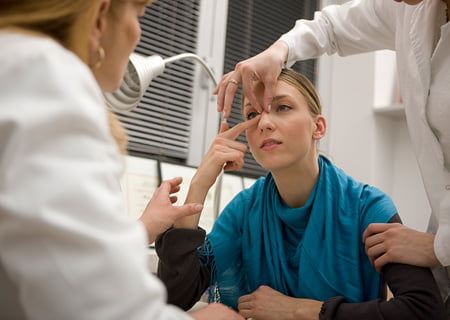
A crooked nose consultation should be more detailed than a standard “make my nose smaller” discussion. The surgeon needs to understand what is crooked, why it is crooked, and whether breathing is involved.
The process may include:
| Consultation step | Why it matters |
|---|---|
| Front-view photo assessment | Crooked noses are often most obvious from the front |
| Side and three-quarter views | Helps identify hump, collapse, projection, and tip deviation |
| Base view | Shows nostril asymmetry and tip direction |
| Breathing history | Identifies possible functional symptoms |
| Internal nasal exam | Checks septum, airway, valves, and other obstruction points |
| Trauma history | Old breaks can affect bones, septum, and cartilage |
| Discussion of expectations | Helps separate realistic improvement from perfect symmetry |
| Surgical planning | Determines whether cosmetic rhinoplasty, septoplasty, or septorhinoplasty is appropriate |
Dr. Kristina Zakhary notes that diagnosis of a deviated septum involves a physical exam, including looking inside the nose with a bright light and nasal speculum.
Recovery after crooked nose rhinoplasty
Recovery depends on what was done. A cosmetic-only case may feel different from a case involving septoplasty, osteotomies, or more complex structural correction.
If septal work is included, patients may notice more congestion and internal swelling early on. Dr. Kristina Zakhary describes septoplasty recovery as usually requiring a few days of recovery and about a week of downtime on average, though this varies by patient and procedure.
For rhinoplasty generally, visible swelling improves gradually. Doctor notes that it can take up to a year after rhinoplasty for the nose to fully heal.
| Recovery factor | Cosmetic-only crooked nose correction | Septoplasty or septorhinoplasty involved |
|---|---|---|
| Congestion | Common but may be less internal | Often more noticeable early on |
| Bruising/swelling | Depends on bone work | Can be similar if osteotomies are used |
| Breathing improvement | Not the main goal | May improve gradually as swelling settles |
| Internal care | Usually simpler | May include more nasal care instructions |
| Final straightness | Takes months to judge | Also takes months, especially if swelling is uneven |
| Work downtime | Often 1–2 weeks for visible recovery | Similar, but congestion may feel more prominent |
Patients should not judge straightness too early. Swelling rarely settles evenly on both sides.
Recovery chart: when the nose starts to look straighter
This is a general pattern only. Individual recovery depends on the procedure, skin thickness, trauma history, and healing.
| Time after surgery | What the crooked nose may look/feel like |
|---|---|
| First week | Splint, swelling, bruising, congestion; straightness is hard to judge |
| Week 2 | Splint may be removed; nose may look straighter but still swollen |
| Weeks 3–6 | Front-view swelling can make the nose look uneven at times |
| Months 2–3 | Bridge often looks more settled; tip and midline may still change |
| Months 4–6 | Straightness becomes easier to assess in photos |
| 6–12+ months | Final contour becomes clearer; subtle asymmetry may remain |
Crooked nose recovery pattern
| Stage | Visible swelling | How reliable the “straightness” judgment is |
|---|---|---|
| Week 1 | High | Not reliable |
| Week 2 | Moderate to high | Too early |
| Weeks 3–8 | Moderate | Still changing |
| Months 2–3 | Mild to moderate | Somewhat clearer |
| Months 4–6 | Mild | More useful |
| 6–12+ months | Low/subtle | Closest to final result |
Questions to ask before surgery
Before choosing crooked nose surgery, patients should ask direct, practical questions.
| Question | Why it matters |
|---|---|
| Is my crooked nose mainly bone, cartilage, septum, or all three? | The cause affects the surgical plan |
| Do I need septoplasty as well as rhinoplasty? | Breathing and appearance may need combined correction |
| How straight is realistic in my case? | Prevents disappointment after surgery |
| Will my nostrils become more even? | Nostrils are difficult to make perfectly symmetrical |
| Was old trauma likely involved? | Old injuries can make surgery more complex |
| Will grafts be needed? | Grafts may support or camouflage asymmetry |
| When can I judge the front view? | Front-view swelling takes patience |
| What are the risks of persistent asymmetry? | Crooked noses carry a higher risk of residual deviation |
Extended FAQ
Can rhinoplasty fully straighten a crooked nose?
Sometimes it can make the nose look much straighter, but full correction is not always possible. The goal is usually natural-looking improvement. Perfect symmetry is uncommon because the nose, cartilage, septum, and face all have their own asymmetries.
Is crooked nose rhinoplasty different from a regular nose job?
Yes. Crooked nose rhinoplasty often requires more structural work than simple profile refinement. The surgeon may need to address nasal bones, cartilage, septum, tip direction, and breathing all at once.
What is crooked nose surgery?
Crooked nose surgery is a general term for surgery that aims to improve a nose that leans, twists, bends, or looks off-centre. Depending on the case, it may involve rhinoplasty, septoplasty, osteotomies, cartilage grafts, or a combined septorhinoplasty.
What is deviated nose surgery?
People often use “deviated nose surgery” to describe surgery for a nose that looks or functions off-centre. Medically, the plan may involve rhinoplasty for the outside shape and septoplasty for the internal septum.
Can a crooked nose affect breathing?
Sometimes , it can. If the septum, nasal valves, or internal structures are narrowed or shifted, airflow may be reduced. Not every crooked nose causes breathing problems, but breathing should be assessed before surgery.
How do I know if my crooked nose is from a deviated septum?
You cannot always tell from appearance alone. A deviated septum is assessed through history and internal nasal examination. Symptoms may include one-sided blockage, mouth breathing, poor airflow during exercise, or chronic congestion.
Can septoplasty fix how my nose looks?
Septoplasty mainly corrects the septum inside the nose. It may improve support in some cases, but it does not reliably change the outside appearance on its own. If external straightening is also needed, rhinoplasty may be discussed.
What is septorhinoplasty?
Septorhinoplasty combines septoplasty and rhinoplasty. It may be considered when a patient has both breathing issues and visible nasal crookedness.
Is crooked nose rhinoplasty covered by insurance if it affects breathing?
Cosmetic rhinoplasty is usually elective. Functional surgery, such as septoplasty for documented breathing obstruction, may be treated differently depending on the insurer, medical findings, and policy. Patients should confirm directly with the clinic and insurance provider.Septoplasty does not reduce the price of a cosmetic rhinoplasty surgery.
How long until a crooked nose looks straight after surgery?
The nose may look straighter when the splint comes off, but swelling can distort the view for weeks or months. A more reliable idea of straightness often develops over several months, while final healing can take around a year or longer.
Why does my nose still look crooked after the splint comes off?
Early swelling is uneven. One side may stay puffier than the other. The tip may also look off-centre while the tissues are firm. This does not always mean the surgery failed.
Can a broken nose from years ago still be fixed?
Often, yes. Old nasal fractures may be improved with rhinoplasty or septorhinoplasty, depending on the bones, cartilage, septum, and skin. Long-standing trauma can be more complex than a recent injury.
Will my nostrils become symmetrical?
They may become more balanced, but perfectly identical nostrils are not realistic for most patients. Nostril shape depends on cartilage, skin, scars, facial asymmetry , and healing.
Is crooked nose rhinoplasty more difficult?
It can be. Straightening a nose requires structural planning, not just reducing a bump. Crooked noses may have cartilage memory, old trauma, septal deviation, and uneven support.
Can filler fix a crooked nose instead of surgery?
In selected cases, filler can camouflage mild irregularities, but it cannot straighten bones, correct the septum, or improve breathing. Filler in the nose also carries specific risks and should only be performed by a properly trained medical professional.
Can a crooked nose come back after surgery?
Some residual deviation can remain or become more visible as swelling resolves. Cartilage memory, scar tissue, healing forces, and trauma after surgery can all affect the final result.
Will crooked nose rhinoplasty change my whole face?
It can change facial balance, especially from the front view and three-quarter view. The goal is usually not to make the face look different, but to make the nose draw less attention.
What should I bring to consultation?
Bring clear concerns, photos if helpful, details about old injuries, breathing symptoms, allergy history, previous nasal treatments, and any questions about work, sport, or recovery timing.
Is surgery worth it for a slightly crooked nose?
It depends on how much the crookedness bothers the patient, whether breathing is affected, and whether the expected improvement is worth the recovery and surgical risks. Mild crookedness may not need surgery.
Key takeaway
Crooked nose rhinoplasty is about improvement, balance, and function — not chasing a perfectly straight line. The best plan identifies why the nose is crooked, checks whether breathing is involved, and uses enough structure to make the result look natural rather than forced.